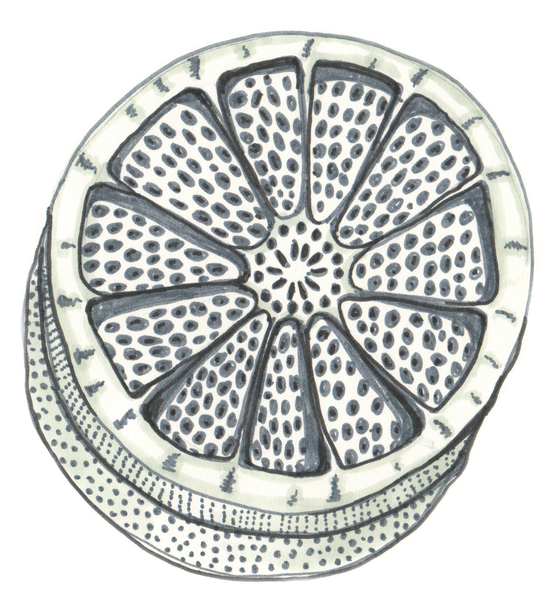
A centric diatom, another type of phytoplankton. Art credit: Kristen Krumhardt
Overview
In previous notebooks, we explored the distribution of different nutrients in the ocean. Here we examine how the growth of phytoplankton communities is limited by these nutrient distributions.
General setup
Subsetting
Processing - long-term mean
Mapping nutrient limitation at the surface
Mapping biomass-weighted nutrient limitation in the top 100m
Making monthly climatology maps
Prerequisites
| Concepts | Importance | Notes |
|---|---|---|
| Matplotlib | Necessary | |
| Intro to Cartopy | Necessary | |
| Dask Cookbook | Helpful | |
| Intro to Xarray | Helpful |
Time to learn: 30 min
Imports
import xarray as xr
import glob
import numpy as np
import matplotlib.pyplot as plt
import matplotlib.colors
import cartopy
import cartopy.crs as ccrs
import pop_tools
from dask.distributed import LocalCluster
import s3fs

from module import adjust_pop_grid
---------------------------------------------------------------------------
ModuleNotFoundError Traceback (most recent call last)
Cell In[1], line 8
4 import matplotlib.pyplot as plt
5 import matplotlib.colors
6 import cartopy
7 import cartopy.crs as ccrs
----> 8 import pop_tools
9 from dask.distributed import LocalCluster
10 import s3fs
11
File ~/micromamba/envs/ocean-bgc-cookbook-dev/lib/python3.14/site-packages/pop_tools/__init__.py:4
1 """Top-level module for pop_tools"""
----> 4 from pkg_resources import DistributionNotFound, get_distribution
6 from .calc import cfc11sol, cfc12sol
7 from .datasets import DATASETS
ModuleNotFoundError: No module named 'pkg_resources'General setup (see intro notebooks for explanations)
Connect to cluster
cluster = LocalCluster()
client = cluster.get_client()
Bring in POP grid utilities
ds_grid = pop_tools.get_grid('POP_gx1v7')
lons = ds_grid.TLONG
lats = ds_grid.TLAT
depths = ds_grid.z_t * 0.01
Load the data
jetstream_url = 'https://js2.jetstream-cloud.org:8001/'

s3 = s3fs.S3FileSystem(anon=True, client_kwargs=dict(endpoint_url=jetstream_url))

# Generate a list of all files in CESM folder
s3path = 's3://pythia/ocean-bgc/cesm/g.e22.GOMIPECOIAF_JRA-1p4-2018.TL319_g17.4p2z.002branch/ocn/proc/tseries/month_1/*'
remote_files = s3.glob(s3path)
s3.invalidate_cache()

# Open all files from folder
fileset = [s3.open(file) for file in remote_files]

# Open with xarray
ds = xr.open_mfdataset(fileset, data_vars="minimal", coords='minimal', compat="override", parallel=True,
                       drop_variables=["transport_components", "transport_regions", 'moc_components'], decode_times=True)

dsSubsetting
variables =['sp_Fe_lim_Cweight_avg_100m','sp_P_lim_Cweight_avg_100m','sp_N_lim_Cweight_avg_100m',
             'diat_Fe_lim_Cweight_avg_100m', 'diat_P_lim_Cweight_avg_100m','diat_N_lim_Cweight_avg_100m',
             'diat_SiO3_lim_Cweight_avg_100m','diaz_P_lim_Cweight_avg_100m',
             'diaz_Fe_lim_Cweight_avg_100m','cocco_Fe_lim_Cweight_avg_100m','cocco_C_lim_Cweight_avg_100m','cocco_N_lim_Cweight_avg_100m',
             'cocco_P_lim_Cweight_avg_100m','sp_Fe_lim_surf','sp_P_lim_surf','sp_N_lim_surf',
             'diat_Fe_lim_surf', 'diat_P_lim_surf','diat_N_lim_surf','diat_SiO3_lim_surf',
             'diaz_P_lim_surf','cocco_Fe_lim_surf','cocco_C_lim_surf','cocco_N_lim_surf',
             'cocco_P_lim_surf','diaz_Fe_lim_surf']
keep_vars=['z_t','z_t_150m','dz','time_bound', 'time', 'TAREA','TLAT','TLONG'] + variables
ds = ds.drop_vars([v for v in ds.variables if v not in keep_vars])
Processing - long-term mean
Pull in the function we defined in the nutrients notebook...
def year_mean(ds):
    """
    Properly convert monthly data to annual means, taking into account month lengths.
    Source: https://ncar.github.io/esds/posts/2021/yearly-averages-xarray/
    """

    # Make a DataArray with the number of days in each month, size = len(time)
    month_length = ds.time.dt.days_in_month

    # Calculate the weights by grouping by 'time.season'
    weights = (
        month_length.groupby("time.year") / month_length.groupby("time.year").sum()
    )

    # Test that the sum of the weights for each season is 1.0
    np.testing.assert_allclose(weights.groupby("time.year").sum().values, np.ones((len(ds.groupby("time.year")), )))

    # Calculate the weighted average
    return (ds * weights).groupby("time.year").sum(dim="time")
Take the long-term mean of our data set. We process monthly to annual with our custom function, then use xarray’s built-in .mean() function to process from annual data to a single mean over time, since each year is the same length.
ds_year = year_mean(ds).mean("year")Mapping nutrient limitation at the surface
Phytoplankton need a specific ratio of nutrients to grow and produce organic matter. In general, this is known as the Redfield ratio, first proposed by Redfield et al., 1963, and is approximately 106 C:16 N:1 P. Micronutrients like silicate and iron are also needed in more variable amounts depending on plankton type. To learn more about nutrient limitation, see Sarmiento and Gruber Chapter 4: Organic Matter Production. Our dataset uses a numerical notation to specify which nutrient is limiting in each area for each phytoplankton functional type, as specified below:
0 = PO4
1 = Fe
2 = NO3 (only for small phytoplankton and diatoms)
3 = Si (only for diatoms)
3 = C (only for coccolithophores)
To turn this information into a single array, we concatenate the limitation terms along the nutrient dimension for each phytoplankton functional type.
limarray_sp=xr.concat((ds_year.sp_P_lim_surf, ds_year.sp_Fe_lim_surf,ds_year.sp_N_lim_surf),dim='nutrient')
limarray_diat=xr.concat((ds_year.diat_P_lim_surf, ds_year.diat_Fe_lim_surf, ds_year.diat_N_lim_surf, ds_year.diat_SiO3_lim_surf),dim='nutrient')
limarray_diaz=xr.concat((ds_year.diaz_P_lim_surf, ds_year.diaz_Fe_lim_surf),dim='nutrient')
limarray_cocco=xr.concat((ds_year.cocco_P_lim_surf, ds_year.cocco_Fe_lim_surf, ds_year.cocco_N_lim_surf, ds_year.cocco_C_lim_surf),dim='nutrient')

most_lim_sp=limarray_sp.argmin(dim='nutrient', skipna=False).squeeze()
most_lim_diat=limarray_diat.argmin(dim='nutrient', skipna=False).squeeze()
most_lim_diaz=limarray_diaz.argmin(dim='nutrient', skipna=False).squeeze()
most_lim_cocco=limarray_cocco.argmin(dim='nutrient', skipna=False).squeeze()
mask = np.isnan(ds_year.sp_N_lim_surf.squeeze())
fig = plt.figure(figsize=(8,13))
colorbar_specs = {'ticks' : np.arange(0,4,1)}
ax = fig.add_subplot(4,1,2, projection=ccrs.Robinson(central_longitude=305.0))
ax.set_title('Diat surface nutrient limitation', fontsize=12)
lon, lat, field = adjust_pop_grid(lons, lats, most_lim_diat.where(~mask))
pc=ax.pcolormesh(lon, lat, field, cmap=matplotlib.colormaps['viridis'].resampled(4),vmin=-0.5,vmax=3.5,transform=ccrs.PlateCarree())
land = cartopy.feature.NaturalEarthFeature('physical', 'land', scale='110m', edgecolor='k', facecolor='white', linewidth=0.5)
ax.add_feature(land)
ax = fig.add_subplot(4,1,1, projection=ccrs.Robinson(central_longitude=305.0))
ax.set_title('SP surface nutrient limitation', fontsize=12)
lon, lat, field = adjust_pop_grid(lons, lats, most_lim_sp.where(~mask))
pc=ax.pcolormesh(lon, lat, field, cmap=matplotlib.colormaps['viridis'].resampled(4),vmin=-0.5,vmax=3.5,transform=ccrs.PlateCarree())
land = cartopy.feature.NaturalEarthFeature('physical', 'land', scale='110m', edgecolor='k', facecolor='white', linewidth=0.5)
ax.add_feature(land)
ax = fig.add_subplot(4,1,3, projection=ccrs.Robinson(central_longitude=305.0))
ax.set_title('Cocco surface nutrient limitation', fontsize=12)
lon, lat, field = adjust_pop_grid(lons, lats, most_lim_cocco.where(~mask))
pc=ax.pcolormesh(lon, lat, field, cmap=matplotlib.colormaps['viridis'].resampled(4),vmin=-0.5,vmax=3.5,transform=ccrs.PlateCarree())
land = cartopy.feature.NaturalEarthFeature('physical', 'land', scale='110m', edgecolor='k', facecolor='white', linewidth=0.5)
ax.add_feature(land)
ax = fig.add_subplot(4,1,4, projection=ccrs.Robinson(central_longitude=305.0))
ax.set_title('Diaz surface nutrient limitation', fontsize=12)
lon, lat, field = adjust_pop_grid(lons, lats, most_lim_diaz.where(~mask))
pc=ax.pcolormesh(lon, lat, field, cmap=matplotlib.colormaps['viridis'].resampled(4),vmin=-0.5,vmax=3.5,transform=ccrs.PlateCarree())
land = cartopy.feature.NaturalEarthFeature('physical', 'land', scale='110m', edgecolor='k', facecolor='white', linewidth=0.5)
ax.add_feature(land)
fig.subplots_adjust(right=0.8)
cbar_ax = fig.add_axes([0.85, 0.15, 0.05, 0.7])
cbar = fig.colorbar(pc, cax=cbar_ax,**colorbar_specs)
cbar.ax.set_yticklabels(['P lim', 'Fe lim', 'N lim','SiO3/C lim']);Mapping biomass-weighted nutrient limitation in the top 100m
limarray_sp=xr.concat((ds_year.sp_P_lim_Cweight_avg_100m, ds_year.sp_Fe_lim_Cweight_avg_100m,ds_year.sp_N_lim_Cweight_avg_100m),dim='nutrient')
limarray_diat=xr.concat((ds_year.diat_P_lim_Cweight_avg_100m, ds_year.diat_Fe_lim_Cweight_avg_100m, ds_year.diat_N_lim_Cweight_avg_100m, ds_year.diat_SiO3_lim_Cweight_avg_100m),dim='nutrient')
limarray_diaz=xr.concat((ds_year.diaz_P_lim_Cweight_avg_100m, ds_year.diaz_Fe_lim_Cweight_avg_100m),dim='nutrient')
limarray_cocco=xr.concat((ds_year.cocco_P_lim_Cweight_avg_100m, ds_year.cocco_Fe_lim_Cweight_avg_100m, ds_year.cocco_N_lim_Cweight_avg_100m, ds_year.cocco_C_lim_Cweight_avg_100m),dim='nutrient')

most_lim_sp=limarray_sp.argmin(dim='nutrient', skipna=False).squeeze()
most_lim_diat=limarray_diat.argmin(dim='nutrient', skipna=False).squeeze()
most_lim_diaz=limarray_diaz.argmin(dim='nutrient', skipna=False).squeeze()
most_lim_cocco=limarray_cocco.argmin(dim='nutrient', skipna=False).squeeze()
mask = np.isnan(ds_year.sp_N_lim_surf.squeeze())
fig = plt.figure(figsize=(8,13))
colorbar_specs = {'ticks' : np.arange(0,4,1)}
ax = fig.add_subplot(4,1,2, projection=ccrs.Robinson(central_longitude=305.0))
ax.set_title('Diat biomass-weighted nutrient limitation', fontsize=12)
lon, lat, field = adjust_pop_grid(lons, lats, most_lim_diat.where(~mask))
pc=ax.pcolormesh(lon, lat, field, cmap=matplotlib.colormaps['viridis'].resampled(4),vmin=-0.5,vmax=3.5,transform=ccrs.PlateCarree())
land = cartopy.feature.NaturalEarthFeature('physical', 'land', scale='110m', edgecolor='k', facecolor='white', linewidth=0.5)
ax.add_feature(land)
ax = fig.add_subplot(4,1,1, projection=ccrs.Robinson(central_longitude=305.0))
ax.set_title('SP biomass-weighted nutrient limitation', fontsize=12)
lon, lat, field = adjust_pop_grid(lons, lats, most_lim_sp.where(~mask))
pc=ax.pcolormesh(lon, lat, field, cmap=matplotlib.colormaps['viridis'].resampled(4),vmin=-0.5,vmax=3.5,transform=ccrs.PlateCarree())
land = cartopy.feature.NaturalEarthFeature('physical', 'land', scale='110m', edgecolor='k', facecolor='white', linewidth=0.5)
ax.add_feature(land)
ax = fig.add_subplot(4,1,3, projection=ccrs.Robinson(central_longitude=305.0))
ax.set_title('Cocco biomass-weighted nutrient limitation', fontsize=12)
lon, lat, field = adjust_pop_grid(lons, lats, most_lim_cocco.where(~mask))
pc=ax.pcolormesh(lon, lat, field, cmap=matplotlib.colormaps['viridis'].resampled(4),vmin=-0.5,vmax=3.5,transform=ccrs.PlateCarree())
land = cartopy.feature.NaturalEarthFeature('physical', 'land', scale='110m', edgecolor='k', facecolor='white', linewidth=0.5)
ax.add_feature(land)
ax = fig.add_subplot(4,1,4, projection=ccrs.Robinson(central_longitude=305.0))
ax.set_title('Diaz biomass-weighted nutrient limitation', fontsize=12)
lon, lat, field = adjust_pop_grid(lons, lats, most_lim_diaz.where(~mask))
pc=ax.pcolormesh(lon, lat, field, cmap=matplotlib.colormaps['viridis'].resampled(4),vmin=-0.5,vmax=3.5,transform=ccrs.PlateCarree())
land = cartopy.feature.NaturalEarthFeature('physical', 'land', scale='110m', edgecolor='k', facecolor='white', linewidth=0.5)
ax.add_feature(land)
fig.subplots_adjust(right=0.8)
cbar_ax = fig.add_axes([0.85, 0.15, 0.05, 0.7])
cbar = fig.colorbar(pc, cax=cbar_ax,**colorbar_specs)
cbar.ax.set_yticklabels(['P lim', 'Fe lim', 'N lim','SiO3/C lim']);Making monthly climatology maps
Make a monthly climatology dataset
A monthly climatology is a dataset where data from each month, including over different years, is averaged together. So for our dataset, the groups would include the average of all Januaries 2010-2019, all Februaries 2010-2019, and so on. This would usually be over a longer time period such as 30 or more years, but we use our shorter dataset so that it processes faster. This technique is helpful for looking at seasonal phenomena while averaging out year-to-year fluctuations.
mon_ds = ds.copy()
mon_ds = ds.groupby('time.month').mean('time')
limarray_sp=xr.concat((mon_ds.sp_P_lim_surf, mon_ds.sp_Fe_lim_surf,mon_ds.sp_N_lim_surf),dim='nutrient')
limarray_diat=xr.concat((mon_ds.diat_P_lim_surf, mon_ds.diat_Fe_lim_surf, mon_ds.diat_N_lim_surf, mon_ds.diat_SiO3_lim_surf),dim='nutrient')
limarray_diaz=xr.concat((mon_ds.diaz_P_lim_surf, mon_ds.diaz_Fe_lim_surf),dim='nutrient')
limarray_cocco=xr.concat((mon_ds.cocco_P_lim_surf, mon_ds.cocco_Fe_lim_surf, mon_ds.cocco_N_lim_surf, mon_ds.cocco_C_lim_surf),dim='nutrient')
most_lim_sp=limarray_sp.argmin(dim='nutrient', skipna=False)
most_lim_diat=limarray_diat.argmin(dim='nutrient', skipna=False)
most_lim_diaz=limarray_diaz.argmin(dim='nutrient', skipna=False)
most_lim_cocco=limarray_cocco.argmin(dim='nutrient', skipna=False)
mask = np.isnan(ds_year.sp_N_lim_surf.squeeze())fig = plt.figure(figsize=(12,23))
month_list = ["Jan", "Feb", "Mar", "Apr", "May", "Jun", "Jul", "Aug", "Sep", "Oct", "Nov", "Dec"]
for row in np.arange(1,13):
ts=row-1
plot = row*3 - 2
#row 1 Jan
ax = fig.add_subplot(12,3,plot, projection=ccrs.Robinson(central_longitude=305.0))
ax.set_title('Diat surface nutrient limitation', fontsize=12)
lon, lat, field = adjust_pop_grid(lons, lats, most_lim_diat.isel(month=ts).where(~mask))
pc=ax.pcolormesh(lon, lat, field, cmap=matplotlib.colormaps['viridis'].resampled(4),vmin=-0.5,vmax=3.5,transform=ccrs.PlateCarree())
land = cartopy.feature.NaturalEarthFeature('physical', 'land', scale='110m', edgecolor='k', facecolor='white', linewidth=0.5)
ax.add_feature(land)
ax.set_ylabel(month_list[ts])
ax.set_yticks([]) # necessary to get ylabel to show up
colorbar_specs = {'ticks' : np.arange(0,4,1)}
plot = row*3 - 1
ax = fig.add_subplot(12,3,plot, projection=ccrs.Robinson(central_longitude=305.0))
ax.set_title('SP surface nutrient limitation', fontsize=12)
lon, lat, field = adjust_pop_grid(lons, lats, most_lim_sp.isel(month=ts).where(~mask))
pc=ax.pcolormesh(lon, lat, field, cmap=matplotlib.colormaps['viridis'].resampled(4),vmin=-0.5,vmax=3.5,transform=ccrs.PlateCarree())
land = cartopy.feature.NaturalEarthFeature('physical', 'land', scale='110m', edgecolor='k', facecolor='white', linewidth=0.5)
ax.add_feature(land)
colorbar_specs = {'ticks' : np.arange(0,4,1)}
plot = row*3
ax = fig.add_subplot(12,3,plot, projection=ccrs.Robinson(central_longitude=305.0))
ax.set_title('Cocco surface nutrient limitation', fontsize=12)
lon, lat, field = adjust_pop_grid(lons, lats, most_lim_cocco.isel(month=ts).where(~mask))
pc=ax.pcolormesh(lon, lat, field, cmap=matplotlib.colormaps['viridis'].resampled(4),vmin=-0.5,vmax=3.5,transform=ccrs.PlateCarree())
land = cartopy.feature.NaturalEarthFeature('physical', 'land', scale='110m', edgecolor='k', facecolor='white', linewidth=0.5)
ax.add_feature(land)
colorbar_specs = {'ticks' : np.arange(0,4,1)}
fig.subplots_adjust(right=0.8)
cbar_ax = fig.add_axes([0.85, 0.15, 0.05, 0.7])
cbar = fig.colorbar(pc, cax=cbar_ax,**colorbar_specs)
cbar.ax.set_yticklabels(['P lim', 'Fe lim', 'N lim','SiO3/C lim']);And close the Dask cluster we spun up at the beginning.
cluster.close()Summary
You’ve learned how to evaluate phytoplankton nutrient limitation.
Resources and references
Sarmiento and Gruber Chapter 4: Organic Matter Production (see Limiting Nutrient in Section 4.2)
- (2013). In Ocean Biogeochemical Dynamics (pp. 102–172). Princeton University Press. 10.2307/j.ctt3fgxqx.7