Overview
When a Fourier series is used to approximate a function with a jump discontinuity, the partial sums do not converge uniformly near the discontinuity. Instead, they overshoot the true value of the function on either side of the jump by a fixed proportion no matter how many terms are added. This persistent overshoot, which becomes narrower but never smaller in amplitude as more modes are included, is known as the Gibbs phenomenon.
The code in this notebook is adapted from Brunton & Kutz (2022)
Imports
import os
import numpy as np
import matplotlib.pyplot as plt
from matplotlib import animation, rc
from IPython.display import HTML
import seaborn as sns
sns.set_theme(style='whitegrid', context='notebook', font_scale=1.3,)
The square wave
dx = 0.01
L = 10
x = np.arange(0, L+dx, dx)
n = len(x)
nquart = int(np.floor(n/4)) # 1/4 of the total length

f = np.zeros_like(x)
f[nquart:3*nquart] = 1 # L/4 to 3L/4 is 1, 0 otherwise

plt.plot(x, f, color='k', linewidth=2)
plt.title('Square Wave')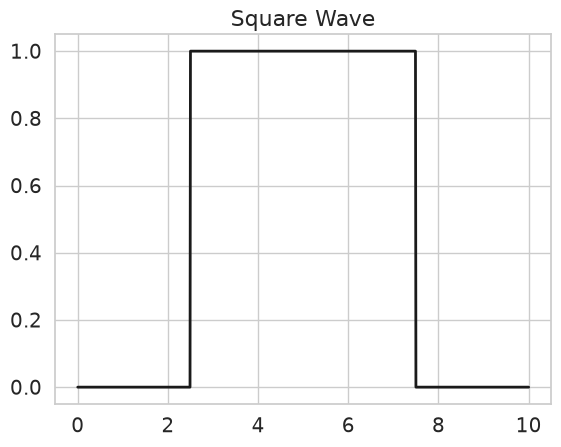
Fourier Series
Any reasonably well-behaved -periodic function can be expanded as an infinite sum of sines and cosines:
The constant term is the average value of over one period, and each pair gives the contribution of the -th harmonic, a wave whose period is .
The coefficients are obtained by projecting onto each basis function (using the orthogonality of sines and cosines on ):
In the code below these integrals are approximated by Riemann sums over the discrete grid (np.sum(...) * dx). A truncated series with modes,
Approximate the square wave
# A0 is the projection of f onto the constant basis function (cos(0) = 1)
k = 0
A0 = np.sum(f * np.cos(np.pi*(k)*x/L)) * dx * 2 / L
fFS = A0/2 * np.ones_like(f)

fig, ax = plt.subplots()
ax.plot(x, f, color='k', linewidth=2)
fFS_plot, = ax.plot([], [], color='r', linewidth=2)

all_fFS = np.zeros((len(fFS), 101))
all_fFS[:, 0] = fFS

# A[k] and B[k] are the cosine and sine Fourier coefficients for mode k+1.
for k in range(1, 101):
    Ak = np.sum(f * np.cos(2*np.pi*k*x/L)) * dx * 2 / L
    Bk = np.sum(f * np.sin(2*np.pi*k*x/L)) * dx * 2 / L
    fFS = fFS + Ak*np.cos(2*k*np.pi*x/L) + Bk*np.sin(2*k*np.pi*x/L)
    all_fFS[:, k] = fFS


def init():
    ax.set_xlim(x[0], x[-1])
    ax.set_ylim(-0.2, 1.2)
    return fFS


def animate(iter):
    fFS_plot.set_data(x, all_fFS[:, iter])
    ax.set_title(f'k={iter:03d}')
    return fFS_plot


anim = animation.FuncAnimation(fig, animate, init_func=init,
                               frames=101, interval=50, blit=False,
                               repeat=False)

plt.close(fig)
HTML(anim.to_jshtml())
In the example above, the square wave (discontinuos Hat Function) is reconstructed from its Fourier series. As the number of modes increases, the approximation becomes more accurate in the smooth regions, but characteristic “ears” remain at the edges of the discontinuity. This illustrates a fundamental limitation of Fourier representations for piecewise-smooth signals.
Resources and references
TBD
- Brunton, S. L., & Kutz, J. N. (2022). Data-Driven Science and Engineering : Machine Learning, Dynamical Systems, and Control.